

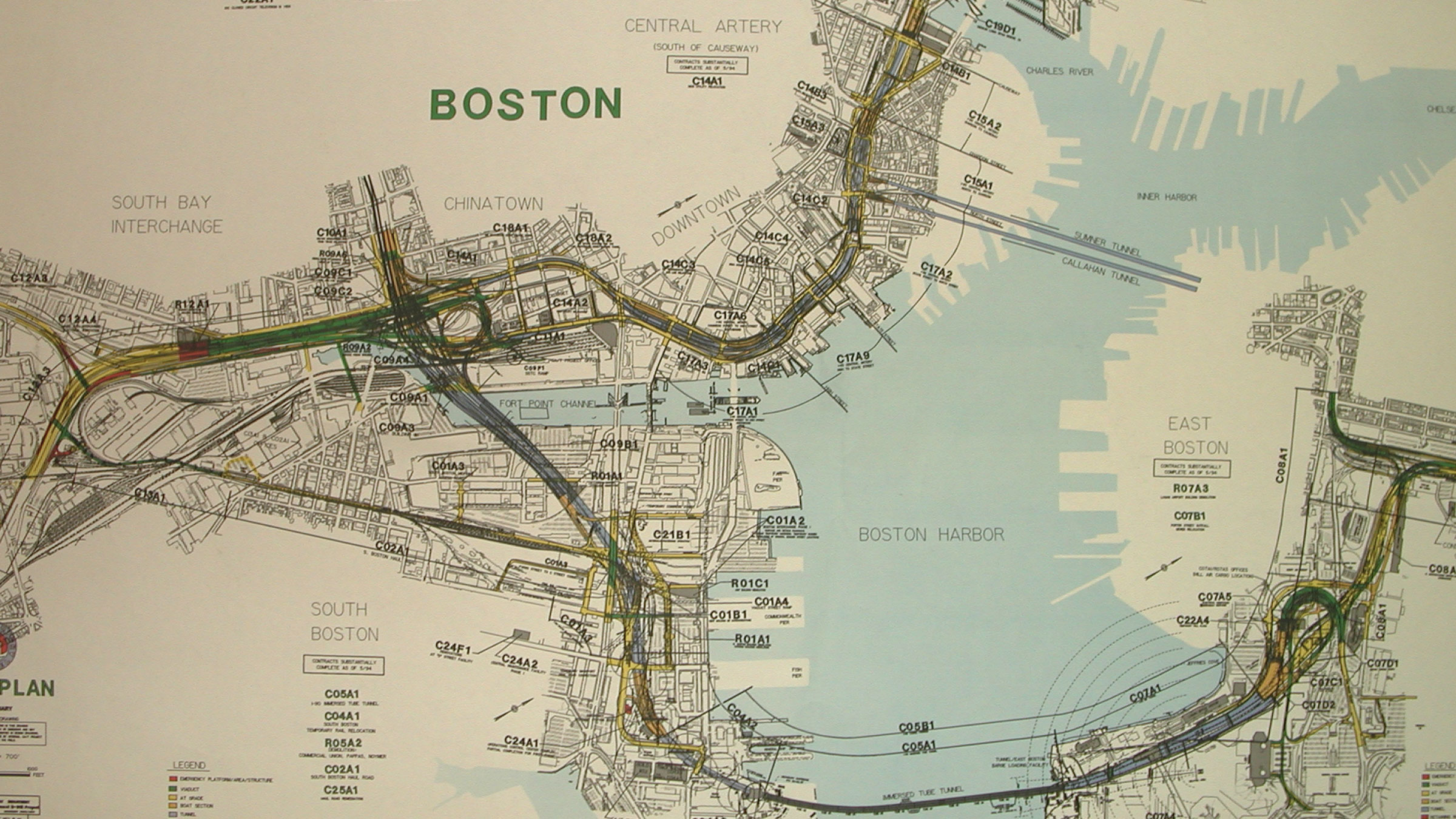
Boston built a highway underneath a highway while drivers continued using the one on top. That was the central engineering problem of the Big Dig. Getting through downtown was difficult enough without turning off I-93 for construction.
The project ultimately put the Central Artery underground, extended the Massachusetts Turnpike to Logan Airport and gave Boston the Zakim Bridge. Its cost grew from an early estimate of roughly $2.6 billion to around $15 billion. A fatal ceiling collapse exposed failures that no new park or shorter airport trip could excuse.
Why Boston needed the Big Dig
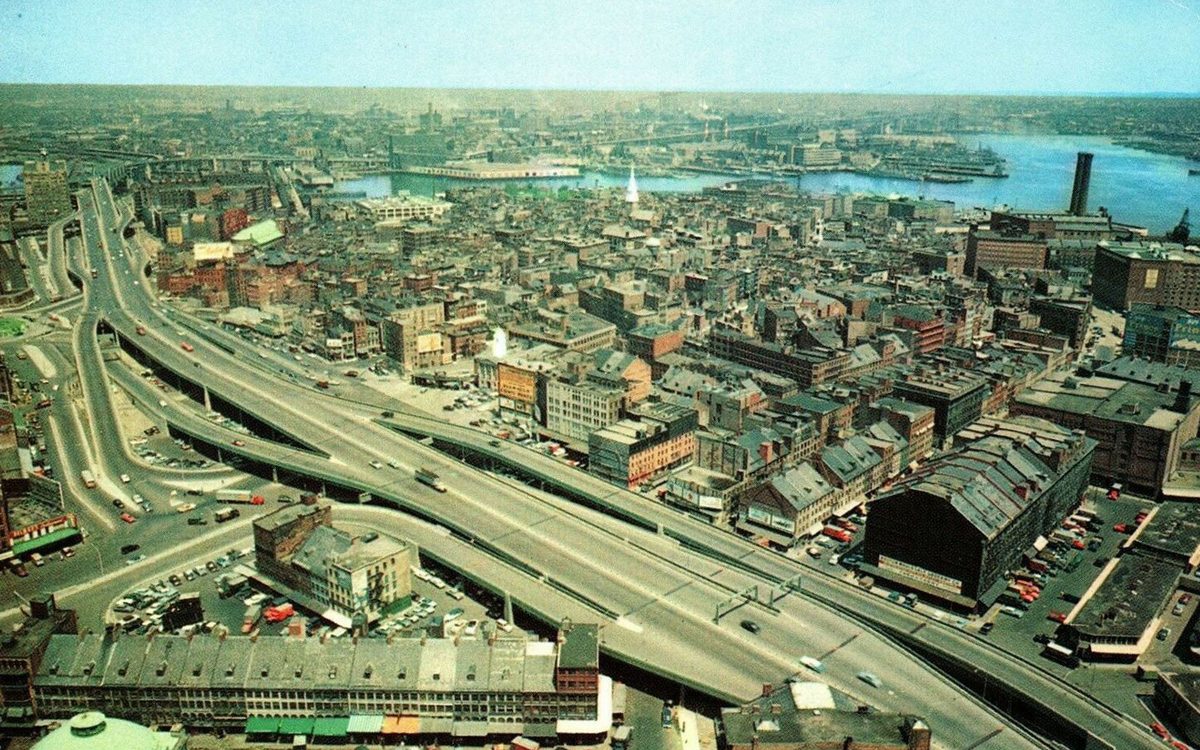
The elevated Central Artery opened in 1959. Within a few decades, Boston was planning an enormously expensive way to get rid of it. The Federal Highway Administration’s account describes a project intended to replace the congested downtown road, improve access to the airport and build a new Charles River crossing.
The road also separated downtown from the North End and waterfront. Removing it offered Boston a chance to recover space that had been surrendered to highway traffic.
Officially called the Central Artery/Tunnel Project, it broke ground in 1991 after a long argument over federal funding. Individual roads opened as construction progressed; drivers were using major pieces of the project well before the last work was finished.
Digging beneath a functioning city
Before crews could build the underground highway, they had to deal with what Boston had already buried.
The project relocated 29 miles of utility lines, maintained by 31 separate companies. Gas, water, electricity and telephone service still had to work while excavation proceeded nearby.
Workers installed deep, reinforced-concrete walls that supported the existing elevated highway and became the walls of the new tunnels. The old road stayed in service above the work. Below ground, the new highway had to fit around subway infrastructure, passing beneath the Red Line at Dewey Square and above the Blue Line at State Street.
This was considerably more complicated than digging a trench and putting a lid on it. Crews were rearranging a working city, including infrastructure whose location and condition were not always reliably recorded.
Two highways, different tunnels
The downtown replacement for I-93 is the Thomas P. O’Neill Jr. Tunnel, the road that took the place of the elevated Central Artery. Its traffic runs beneath the downtown corridor where the old highway once cut through the city.
The Ted Williams Tunnel carries I-90 beneath Boston Harbor. It initially opened to commercial traffic while crews completed the connecting roads. The airport crossing and the downtown artery served different routes within the same enormous project.
The harbor tunnel measures about 1.6 miles overall, with roughly three-quarters of a mile underwater. Its submerged section consists of tubes placed in a trench on the harbor floor. The Federal Highway Administration’s description of the tunnel explains that construction method and its original restricted opening.
Above ground, the ten-lane Leonard P. Zakim Bunker Hill Bridge became the project’s most recognizable structure. Its name honors civil rights activist Leonard Zakim and the Battle of Bunker Hill. Eight lanes run between its towers; two more sit outside them on the eastern side, giving the bridge its asymmetrical shape.

The budget kept getting bigger
An early estimate put the project at $2.56 billion. By 2007, the figure had reached $14.8 billion in an account by former project official Virginia Greiman, published in NASA’s ASK magazine.
Those estimates came from different years, so comparing them directly does not isolate the effect of inflation. But Greiman’s analysis also rejects inflation as a sufficient explanation for the increase.
The problems included underestimated underground conditions, design changes, expanded scope and the expense of keeping businesses, roads and services operating during construction. Management arrangements made coordination harder: designers and contractors worked under separate contracts, while decisions involved numerous agencies and other parties.
The construction was difficult. The original budget also failed to capture how difficult it would be. Boston paid for both.
The ceiling collapse that killed Milena Del Valle
On July 10, 2006, concrete ceiling panels and their suspension hardware fell onto a car in the I-90 connector tunnel near D Street. Passenger Milena Del Valle was killed. Her husband, who was driving, survived with minor injuries.
The National Transportation Safety Board investigation identified an epoxy adhesive unsuitable for supporting the ceiling’s weight over the long term. Under sustained load, the material gradually deformed and fractured, allowing anchors to pull free.
Investigators also found failures in design review, information supplied about the adhesive, monitoring and inspection. Earlier anchor movement had provided warning signs. The NTSB concluded that a timely tunnel inspection program would likely have detected the developing problem before the collapse.
This was a preventable failure with a person’s life at its center.

What Boston got back above ground
The airport connection and the removal of the elevated artery changed how people could get through the city. They did not promise a future in which Boston would stop having traffic.
The change above ground is easier to see. The Rose Kennedy Greenway opened in October 2008, creating public parkland along the former elevated highway corridor and reconnecting neighborhoods with the waterfront.
That makes the project part of an ordinary afternoon in the North End, too. Walk toward the waterfront and you cross parkland where the old highway used to stand. The parks belong in the accounting alongside the roads, the bills and the failures.
Along the Greenway, the space once occupied by the elevated artery now accommodates gardens, walking paths and places to sit. You do not need to own a car to use that part of the Big Dig.
