


Underground passages beneath the North End gave Boston a story involving waterfront smugglers, church basements and cemetery crypts. Captain Thomas Gruchy became one of its principal characters: a seafaring churchgoer supposedly conducting less respectable business below street level.
The North End tunnels have a basis in historical accounts. The sprawling pirate network is a different proposition. Old North Church’s description of its 2020 talk on the tunnels makes that distinction explicitly, identifying underground discoveries as the foundation for stories that accumulated considerably more adventurous details.
The interesting question is what those passages were for. The stories offer barrels, stolen goods and secret escape routes. The surviving evidence is less cooperative.

What the accounts say about the North End tunnels
The historical accounts include Charles Shaw’s A Topographical and Historical Description of Boston, Samuel Adams Drake’s Old Landmarks and Historic Personages of Boston and Edward Griffin Porter’s Rambles in Old Boston. These are among the works collected in HUB History’s investigation of the tunnels.
The episode’s accompanying material includes an entrance illustration from Porter’s 1887 book and tunnel illustrations published by the Boston Globe in 1896 and 1906. It also identifies a 1906 Los Angeles Herald report describing passages being uncovered and filled.
Those accounts give the story something more substantial than neighborhood gossip. They do not, by themselves, establish that every reported opening belonged to one connected system.
HUB History places a reported route near Henchman Street, using John Bonner’s 1722 Boston map to orient readers between a shipyard, the corner of Lynn and Henchman, and Salem Street. That is useful geographical context, not a verified map of an underground route available today.
The same investigation notes independent researchers’ proposed connection to Captain Daniel Henchman. It presents that attribution as their belief, rather than a settled identification of the builder.
Captain Gruchy had enough trouble above ground
Gruchy’s documented career helps explain why his name stuck to the legend. According to Old North’s account of his life, he owned pew 25, bought a substantial house nearby and captained the Queen of Hungary during King George’s War.
The ship operated as a British privateer: a civilian vessel authorized to capture enemy merchant shipping. In 1746, Gruchy captured three French ships bound for French Canada. Among the seized goods were four carved wooden angels, which he gave to Old North.
The angels were real. So was the plunder. Neither proves that he operated a secret smuggling route beneath the neighborhood.
His church membership also should not turn him into a harmless eccentric. Old North’s marriage records identify Tamuse, a woman he enslaved, who married a free Black man named Jerremy in 1751. That documented part of his household deserves a place alongside the more frequently repeated story of his gift.
How a privateer acquired a smuggler’s reputation
Old North’s longer history of Gruchy describes repeated lawsuits, disputed prize money and a venture distilling molasses into rum near what is now Henchman and Commercial Streets.
He sold his house to his father-in-law in 1758. His remaining Boston holdings were sold the following year, and his name largely disappeared from the church’s records.
The church’s account explains that subterranean vaults and tunnels associated with his properties helped generate later accusations of smuggling and piracy. It reports no evidence supporting those accusations.
That leaves an important gap between a passage’s location and its purpose. Property associated with a privateer does not make every structure beneath it a privateering facility. Nor does a waterfront rum business establish illicit cargo moving through a cellar.
A walk around Henchman and Commercial Streets puts the story back in the neighborhood where Gruchy lived and worked. It does not provide an entrance to his supposed tunnels. The historical accounts leave their full extent and original purpose unresolved; they are not directions for a visit underground.
Lovecraft supplied the monsters
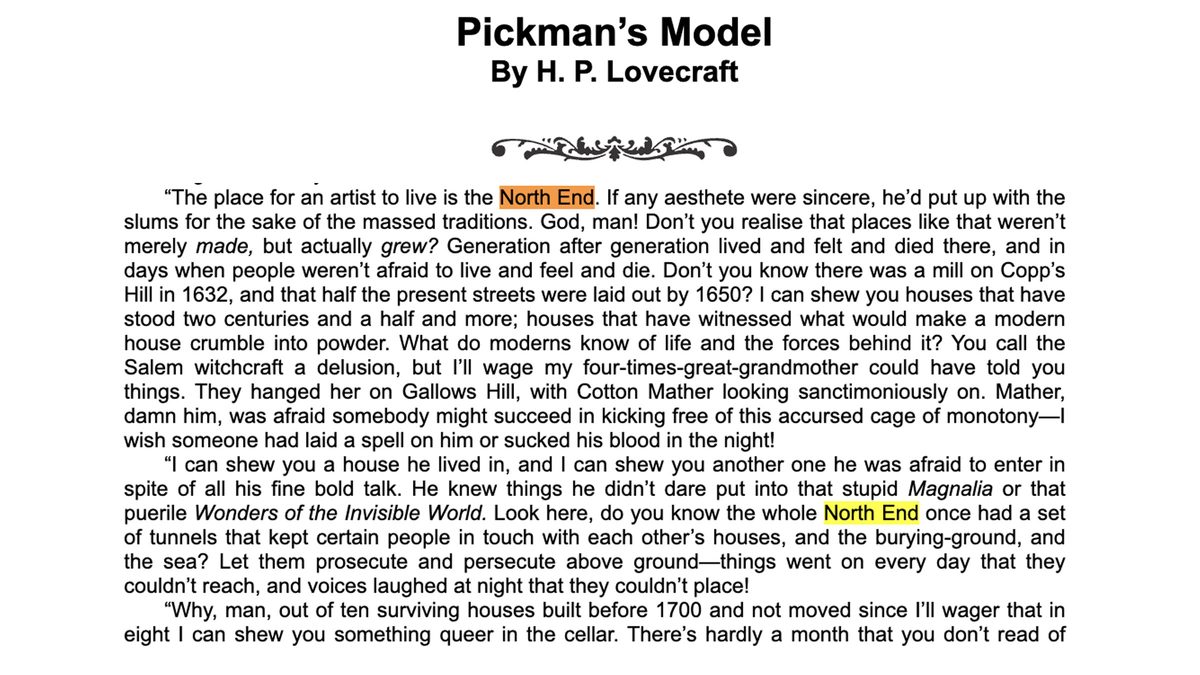
Readers of our secret societies of Boston article will recognize the gap between documented history and a much better rumor. H. P. Lovecraft gave the underground neighborhood a much less restrained treatment in “Pickman’s Model”.
In the story, an artist describes tunnels connecting North End houses, the burying ground and the sea. His concealed studio contains a brick-lined well associated with the passages. The paintings feature creatures feeding in cemeteries and underground spaces, while familiar Boston locations make the horror feel uncomfortably close to an ordinary walk home.
The story is fiction, not testimony about what workmen found. Its Henchman Street references and cellar descriptions belong to a carefully constructed nightmare.
Lovecraft even makes the Boylston Street subway the setting of a monster attack. Apparently, a difficult commute was not enough.