


Fig Newtons were named after Newton, Massachusetts. The cookies came out of a Cambridgeport bakery, which means Newton received the name recognition while Cambridge did the baking. Even though I grew up in JP, I had never heard that the name referred to the place.
The Cambridge Historical Commission traces the cookie to the Kennedy Biscuit Company. The explanation involves a local naming habit and a machine that could put filling inside dough continuously. It is a more practical origin story than a food executive falling in love with a pretty town.

Fig Newtons got a Massachusetts place name
According to the commission’s account, Kennedy named products after nearby towns. Cambridge and Shrewsbury were considered for the fig-filled creation before Newton won out. In that telling, an employee who lived in Newton suggested it.
A 1991 Christian Science Monitor report, quoting Nabisco historian Dave Stivers, credits plant manager James Hazen with the inspiration. It notes that Melrose and Brighton had already supplied names for other cookies.
The accounts differ in their description of the person behind the choice, but agree on the local geography. The name refers to Newton, Massachusetts. There is no need to add an affectionate visit by James L. Kraft to explain it.
That distinction also answers an easy question to get wrong: a cookie bearing Newton’s name does not establish that its factory was in Newton. The relevant bakery was in Cambridgeport, on the other side of the Charles from much of Boston.
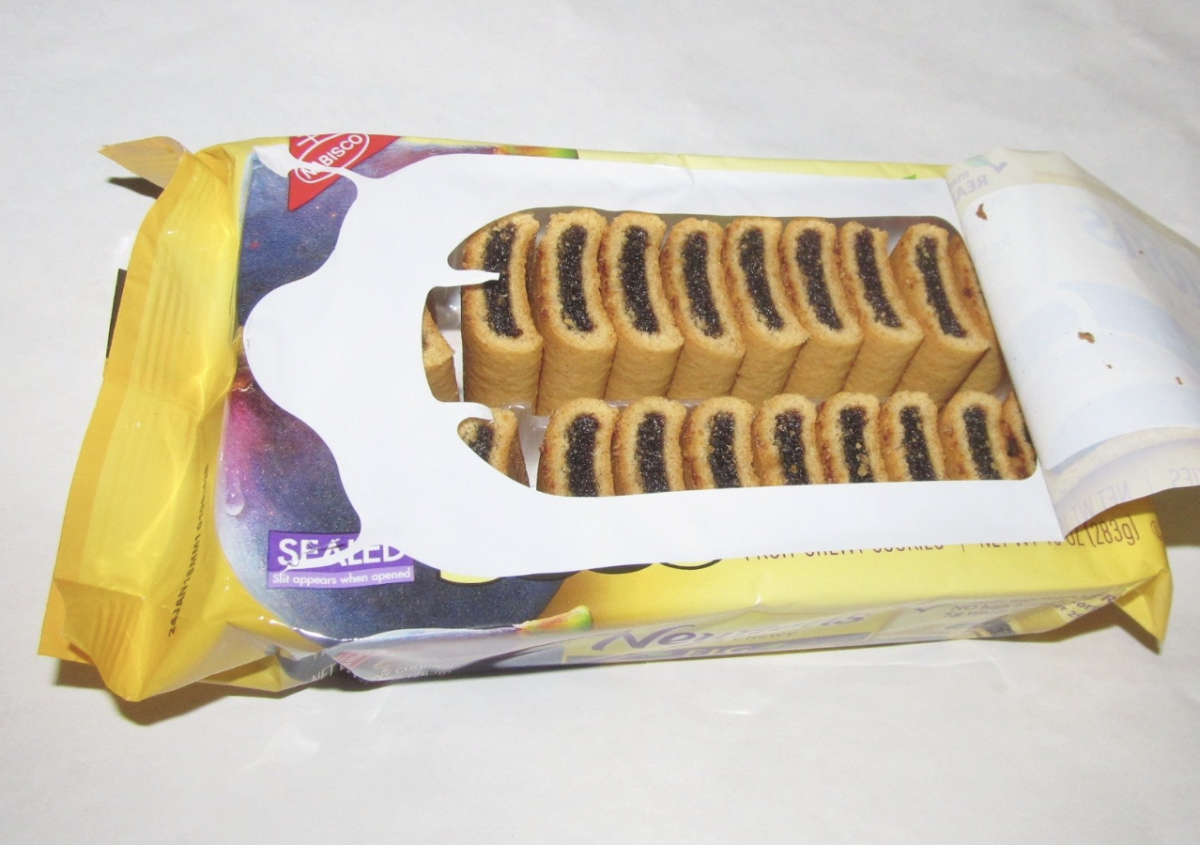
The clever part was getting the filling inside
James Henry Mitchell’s machinery made large-scale production possible. The Monitor describes a funnel within a funnel: one supplied the filling while the other supplied the surrounding dough. The continuous length could then be divided into individual cookies.
Instead of filling and sealing each piece separately, the process formed the outside and inside together. That is the useful bit of engineering hidden in an otherwise ordinary snack. Break one open and the construction becomes obvious: a soft outer layer wrapped around a dense center.
The machine matters because creating something in a kitchen and making enough identical pieces to sell widely are different problems. Consistency requires more than a recipe. The filling has to stay inside, the dough has to hold its shape and the finished pieces have to bake reliably.
Kennedy was already a serious bakery
Frank A. Kennedy inherited the Cambridgeport business from his father, Artemas. A Historical Commission report on the Kennedy family describes how he mechanized its ovens, expanded distribution and built a new Franklin Street factory in 1875. A Chicago factory followed in 1878.
The report is about a former coachman’s house connected to the family’s estate, but the business history makes the scale clear. Kennedy was an industrialist with factories and a distribution network. The fig cookie entered a manufacturing operation that already knew how to produce and sell baked goods.
The brand subsequently became part of the larger biscuit business associated with Nabisco. That later corporate history should not be mistaken for the beginning of the Cambridge bakery itself.
The factory became housing
The old factory survives as Kennedy Biscuit Lofts at 129 Franklin Street. Cambridge’s housing directory lists the property among privately owned developments with affordable units. It is a residential building, not a working cookie factory or a shop where you can buy a warm batch.
The Historical Commission documents the site’s preserved oven and cookie-shaped decorative details. Those remnants make the former use legible even after the baking equipment has mostly gone. If you pass the building, look at the exterior without assuming the residential interior is open to visitors.
For another nearby food invention that became a national habit, Marshmallow Fluff’s story starts in Somerville. The Newton name is less obvious evidence on the supermarket shelf. It has been telling people where it came from, geographically speaking, all along.
