


Boston was named after Boston. The earlier one is in Lincolnshire, England, where a medieval church tower rises above a port and market town. English settlers carried the name across the Atlantic in 1630. Massachusetts made it rather more famous.
The connection is well documented. Historic England describes both the borrowed name and the prominent residents who left the English town to help lead the new settlement. The longer story involves a saint, a minister who arrived after the naming, and a peninsula whose human history did not start when the English showed up.

Boston was named after a port town
Boston, Lincolnshire, was an important trading port long before the Massachusetts settlement existed. Its position connected the town with North Sea commerce, and its surviving warehouses, markets and church reflect that wealth.
St Botolph’s Church is the building most likely to catch your eye. Its tower is known as the Boston Stump, a nickname that undersells a structure visible across the flat surrounding country. The church supplied a religious and civic focal point for the town that gave ours its name.
The name Boston is generally traced to Botolph’s town. The Getty Research Institute’s place-name record includes “Botolph’s Town” among its historical names. By the time the name reached Massachusetts, the shorter form had already done the work.
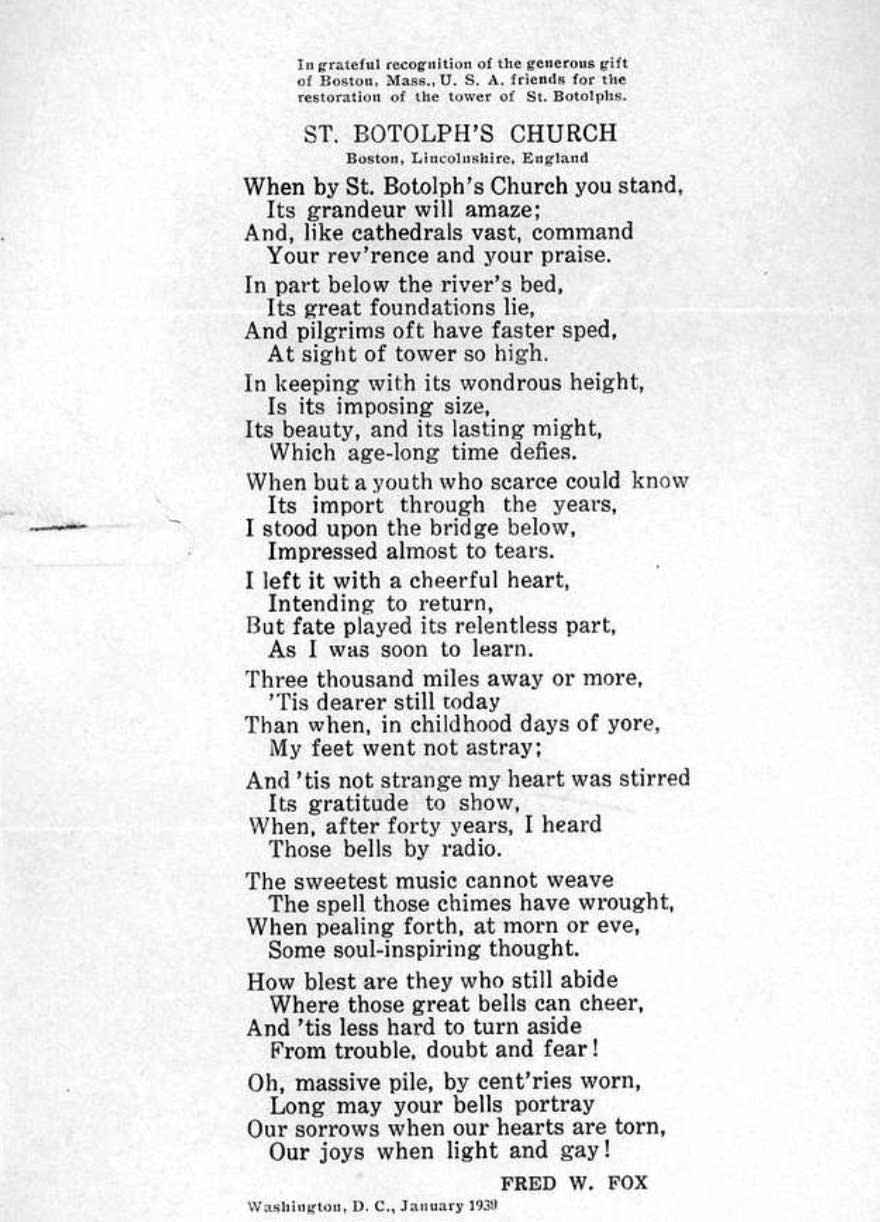
John Cotton came later
John Cotton is an important part of the connection between the two Bostons. He served as vicar of St Botolph’s before settling in Massachusetts. But the dates matter: the American town was named in 1630, and Cotton arrived in 1633.
Boston Borough Council’s account of the transatlantic connection explains how Cotton’s congregation and other local figures linked the English town to New England. It also separates that migration from the earlier story of the Pilgrims.
The English Boston has a Pilgrim connection too. In 1607, separatists trying to leave for the Netherlands were betrayed and arrested there. That episode belongs to the history leading toward the Mayflower voyage, not to a single founding trip that created every English settlement in Massachusetts.
Putting those events into one neat departure story loses the actual sequence. Plymouth’s 1620 settlement and Boston’s 1630 settlement were different undertakings. Cotton’s later arrival strengthened an existing connection rather than creating the name on his first day.

Before Boston there was Shawmut
The English name was new. The inhabited place was not. The City of Boston’s archaeological history of the Common describes thousands of years of Massachusett life in Shawmut and emphasizes that the Massachusett people are still here.
Archaeologists have found stone tools, pottery and shell deposits near the Frog Pond and Parkman Bandstand. Those objects give a much longer account of life on the peninsula than a founding date printed on a city souvenir.
William Blackstone, also spelled Blaxton, was already living on the peninsula when John Winthrop’s settlers arrived. In 1634, he sold land to the colonists that became the Common. The familiar park therefore holds several histories at once: Indigenous use, English settlement and the development of shared public land.
A city name is only part of the map
Boston’s name is comparatively straightforward once you find the English town. The names inside Boston can be less cooperative. Jamaica Plain’s name, for example, has competing explanations rather than one securely documented answer.
For Boston itself, there is no need to invent a secret message or claim the Puritans were asking a saint to protect their new home. A familiar English place name traveled with a community of settlers. Understanding why that name felt familiar requires looking back across the Atlantic; understanding the place it was applied to requires looking much further back here.
The next time you hear “the original Boston,” the speaker may mean a Lincolnshire market town with a very large church. Ours was the sequel.
Members
Join to keep reading
- Members-only perks, like free and discounted tickets
- Access to members hub
- Priority guest list
- Every guide and article, in full
- Save places, events and guides
- Unlimited searches on The MoveA discovery tool that recommends our favorite spots in Boston.
- 15% off Secret Boston merch
$9.99 a month or $99 a year. Cancel anytime.
Already a member? Sign in
Always free