

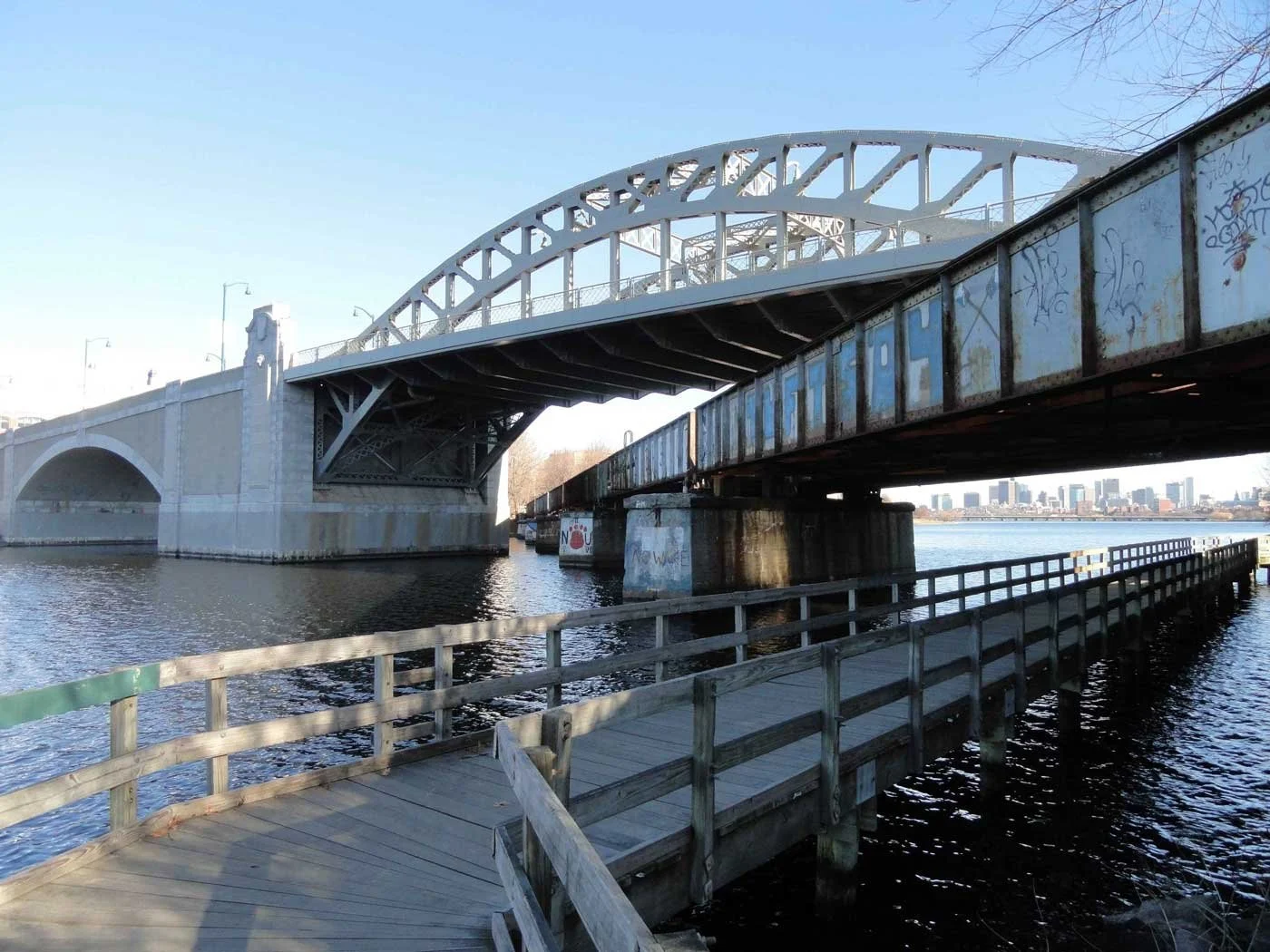
A boat under a train under a car under a plane. That is the BU Bridge story, and the arrangement really is possible. The trouble starts when someone adds “the only place in the world.” Boston has been taking a little too much credit.
The road bridge crosses the Charles River above the Grand Junction railroad bridge. Boats can pass below the railway, and an aircraft can pass above the lot. It is an appealing piece of local trivia because you can see most of the explanation from the riverbank. You do not need an engineering degree. You do need to leave the word “only” out of it.

The BU Bridge has competition
Boston University itself has corrected the claim. In a 2005 explanation of the four-layer story, BU pointed to Portland, Oregon’s Steel Bridge, which also gets credit for accommodating the same combination.
That does not make the Boston version imaginary. It makes the boast too large. There is a difference between a place where four kinds of transportation could line up and a place where nobody else can do it.
Nor is this a scheduled attraction. The story describes a possible arrangement, not a performance that occurs every afternoon. Standing there until a train, boat, car and plane arrive together is a fairly demanding way to spend your walk.
Two bridges do the work
The key is that the road and railroad use separate crossings. Look at the lower steel structure and you can follow the railway beneath the higher roadway. The bridges meet at an angle rather than forming two perfectly aligned decks.
That distinction matters if you are trying to understand a photograph. The train is not traveling inside the road bridge. It has its own route over the Charles. The water provides another path below, while the air above supplies the least exclusive part of the claim.
The railway and road each need their own clearance above the water. In a side view, their separate structures are easier to distinguish than when you are crossing on top. Look along the lower bridge first, then follow the higher road across it.
Students got the bridge renamed
The crossing opened as the Cottage Farm Bridge in 1928. Its university name came later, after BU students pushed for the change. According to the university’s account of the renaming ceremony, students at the Boston University News helped build support, and state senator John E. Powers sponsored the legislation.
The bill passed without a dissenting vote. On May 7, 1949, the new name received a formal ceremony and parade. BU president Daniel L. Marsh unveiled a commemorative plaque, and a motorcade made the ceremonial crossing.
The original 1928 opening had been promoted for a different reason: linking traffic between the North and South Shores. The nearby baseball reference then was Braves Field. The Boston connection did not begin with the trivia question or the university name.
The bridge has changed for cyclists too
The view from the river is only one way to understand the crossing. For people riding over it, the allocation of space on the deck matters much more than a possible aircraft overhead.
BU’s January 2012 report on the renovation described newly added bike lanes and trials of different traffic configurations. The earlier bridge had four lanes for cars and no dedicated bike lanes. The project also addressed pedestrian approaches.
Keeping traffic moving during that construction produced long delays. The work concerned the ordinary problem of making a heavily used bridge safer and more useful, rather than preserving a perfect arrangement for a trivia question.
For a look at how much larger those compromises can become, our Big Dig history follows another Boston effort to fit roads around an existing city. At the BU Bridge, the arrangement is easier to see: two crossings, one river, and no promise that the plane will cooperate.
