


John Singer Sargent once told his sitter Graham Robertson, “The coat is the picture.” A fairly blunt assessment when you’re the person wearing it.
Sargent took clothing seriously. He chose outfits, rearranged fabric and changed details that didn’t suit the painting. Arriving in an expensive dress didn’t mean he would paint it exactly as its designer intended. The folds, color and shape all had to work for him.
Boston’s MFA examined that control in Fashioned by Sargent, pairing portraits with clothing worn by their subjects. The exhibition ran from October 8, 2023, through January 15, 2024, and is now closed. But the stories behind those outfits are worth knowing, particularly in a city where one of Sargent’s clients was Isabella Stewart Gardner.
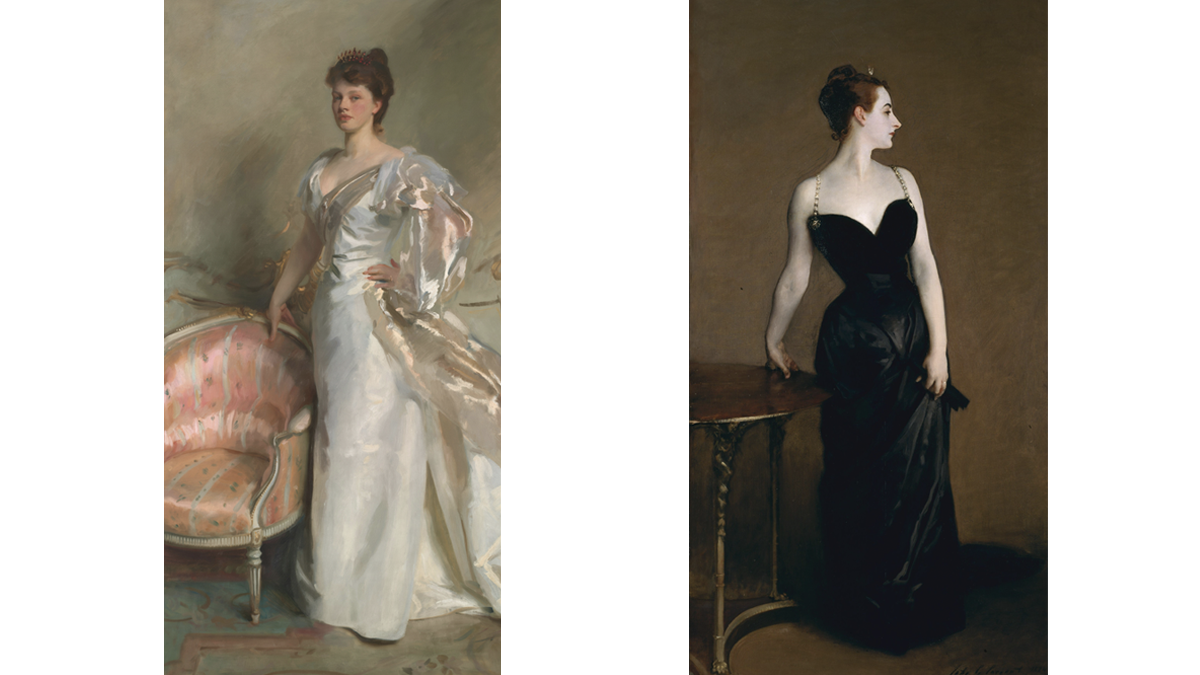
John Singer Sargent decided what made the picture
The MFA and Tate Britain organized the exhibition around a useful distinction: a portrait could tell you what someone wore, but it could also show what Sargent wanted you to see.
According to the MFA’s account of his working methods, he pinned and draped garments, omitted decorative details and sometimes invented them. Clothes helped him suggest a sitter’s position, profession or personality. A faithful record of the dress wasn’t necessarily the assignment.
Consider Dr. Pozzi at Home, painted in 1881. The surgeon appears in a red dressing gown and Turkish slippers. Even his clothes for staying home command attention. The painting makes a useful comparison with the formal evening gowns: Sargent could give a dressing gown just as much presence.
The exhibition brought together approximately 50 paintings and more than a dozen garments and accessories. Seeing the actual clothing beside the portraits allowed visitors to compare the objects with the choices he made in paint.
The shoulder strap that became a problem
In Madame X, a small clothing detail helped turn an ambitious portrait into a public scandal.
The sitter was Virginie Amélie Avegno Gautreau, an American-born society figure in Paris. Sargent painted her without a commission, with her cooperation, hoping the portrait would build his reputation. He showed her in a black gown with its right strap slipping off her shoulder.
When the painting appeared at the Paris Salon in 1884, the response was hostile. The Metropolitan Museum of Art’s account describes objections to her cosmetics, exposed skin and bold presentation, as well as the fallen strap. The outrage concerned both the painting and the woman being painted.
Sargent eventually repainted the strap in place. He kept the portrait for more than 30 years before selling it to the Met in 1916. He changed the dress, but he didn’t disown the picture.
The beetles were real
Ellen Terry’s green Lady Macbeth costume required no invented embellishment. It was decorated with more than 1,000 beetle wings.
Terry wore the dress in the 1888 production of Macbeth at London’s Lyceum Theatre. She worked closely with costume designer Alice Comyns Carr, and the National Trust describes the shimmering surface as intended to suggest a serpent’s scales and inspire fear.
Sargent’s 1889 portrait shows Terry holding a crown above her head. The Boston exhibition reunited the painting with the costume, giving visitors a chance to see that the unusual green shimmer had a very physical explanation.
Another pairing brought the story closer to home: Sargent’s 1887 portrait of Louise Pomeroy Inches, titled Mrs. Charles E. Inches, and her red velvet evening gown. Both belong to the MFA. Their survival allows a comparison across two kinds of museum objects: the clothing someone wore and the image an artist made of her wearing it.

Boston had its own opinions about a neckline
Isabella Stewart Gardner saw Madame X in Sargent’s London studio and commissioned her own portrait. The scandal hadn’t put her off.
He painted her at her Beacon Street home in a Charles Frederick Worth evening gown. An enlarged textile pattern behind her head suggests a halo. The Gardner Museum’s account of the portrait describes the reaction at Boston’s St. Botolph Club in 1888: praise, gossip and sexist comments about a dress no more revealing than other sitters’ outfits.
Her husband, Jack, asked her not to exhibit it publicly again. Access remained by invitation until her death in 1924, though visitors might glimpse it through the Gothic Room’s gate.
Gardner kept a postcard of Madame X and bought Sargent’s smaller painting of Gautreau raising a toast. Boston could object. Isabella had already made her selection.
