


Boston inventions have done a lot for people who don’t like waiting. The telephone let someone hear you without a letter arriving first. Polaroid put a photograph in your hand a minute after you took it. The microwave made reheating dinner considerably less of a project.
All three have roots in the Boston area, though their histories cross city lines and involve more than one celebrated inventor having a good afternoon. Bell worked with Thomas Watson. Edwin Land had a team solving the chemistry of instant film. Percy Spencer’s microwave experiments grew out of wartime radar work at Raytheon.
The useful details are better than the usual claim that Boston invented everything. A camera went on sale at Jordan Marsh. A phone connected a Boston workshop to a Somerville home. An early microwave weighed about as much as something you would hire movers to deal with.
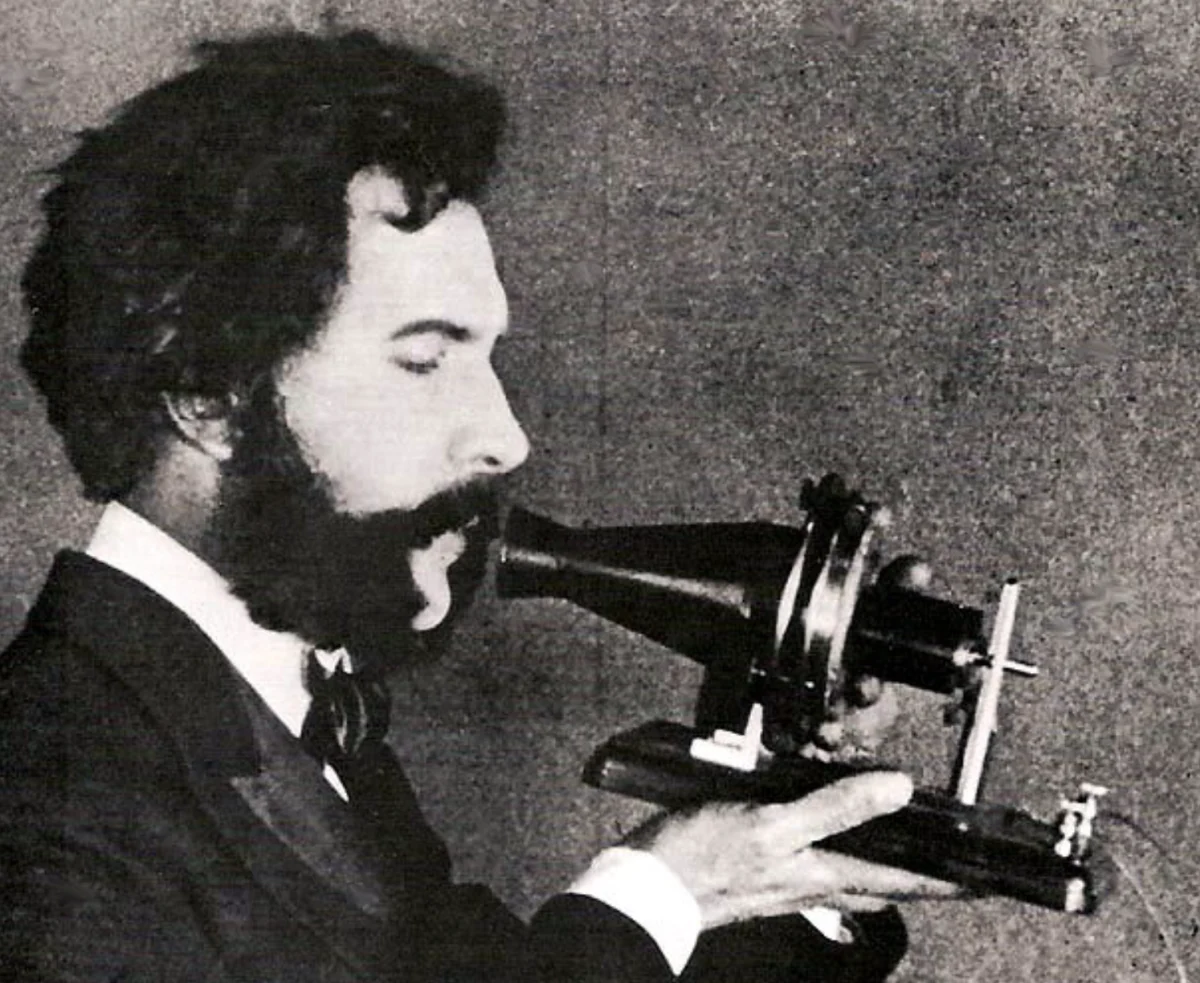
Boston inventions started with a call to the next room
Alexander Graham Bell received his telephone patent on March 7, 1876. Three days later, he and Thomas Watson conducted the experiment remembered for Bell’s request that Watson come to him.
Bell’s journal account, reproduced by Mass Humanities, is wonderfully specific. Watson held the receiving instrument to one ear and covered the other with his hand. The men were in separate rooms with their doors closed. Watson heard Bell’s words and came in to confirm them.
They then swapped positions. Bell could hear Watson reading, but much of it sounded muffled. That detail gets lost when the invention is reduced to a single triumphant sentence. Successful speech transmission did not mean the device was finished.
By April 1877, a telephone line connected Charles Williams’s machine shop at 109 Court Street in Boston with his home in Somerville. In a letter to his wife, Bell described finding Williams talking with his own wife over the line. The laboratory experiment was becoming useful outside the laboratory.
Polaroid made its retail debut at Jordan Marsh
Edwin Land first publicly demonstrated his instant photography system in New York on February 21, 1947. Boston shoppers got their turn on November 26, 1948, when the Land Camera Model 95 and its film went on sale at Jordan Marsh.
Harvard Business School’s Polaroid archive records a camera price of $89.75. All 56 cameras sold that day. The camera weighed more than four pounds, which gives “point and shoot” a slightly different feel.
Those early photographs were sepia-toned. After waiting 60 seconds, the user peeled the print from its negative. The process took care of work that ordinarily happened in a darkroom, but it still demanded attention from the person taking the picture.
The American Chemical Society’s history explains the small chemical pod inside the film unit. Rollers broke it open and spread the processing chemicals across the image. A finished photograph depended on chemistry, timing and the camera mechanism working together.
Land directed the work in Cambridge. Meroë Morse helped develop Polaroid’s true black-and-white film, introduced in 1950; instant color followed in 1963. The familiar product arrived through years of improvements, rather than one finished invention appearing in a shop window.
The microwave began with radar equipment
Percy Spencer worked on magnetrons at Raytheon. These devices generated microwaves for radar, and his manufacturing improvements helped increase their wartime production. Cooking was a different application of the same technology.
According to MIT’s Lemelson biography of Spencer, he noticed a chocolate bar melting in his pocket near a magnetron and tried an experiment with popcorn. Spencer and Raytheon went on to develop a cooking device and filed a patent application on October 8, 1945.
The commercial Radarange followed in 1947. It stood roughly six feet tall, weighed about 750 pounds and cost $3,000. This was equipment for a commercial kitchen, not a small appliance you could carry home.
It took roughly two more decades to produce a more practical home version. The National Inventors Hall of Fame connects Raytheon’s acquisition of Amana in 1965 with its move into larger-scale microwave sales. Before reheating leftovers became a minor household convenience, the machine needed a rather serious diet.