


Before opening Bell in Hand, Jimmy Wilson had a job that made him hard to ignore. He was Boston’s town crier, delivering the news aloud. When he retired, according to the tavern’s own history, he traded public announcements for pouring ale and named the business after the bell he had carried.
Bell in Hand traces its founding to 1795. Today, it serves food and drinks at 45 Union Street, beside some of downtown’s narrowest old lanes. You can stop for a bowl of chowder after walking around Faneuil Hall or come back later for the bar. Either way, its history deserves a little more attention than the oldest-tavern claim.
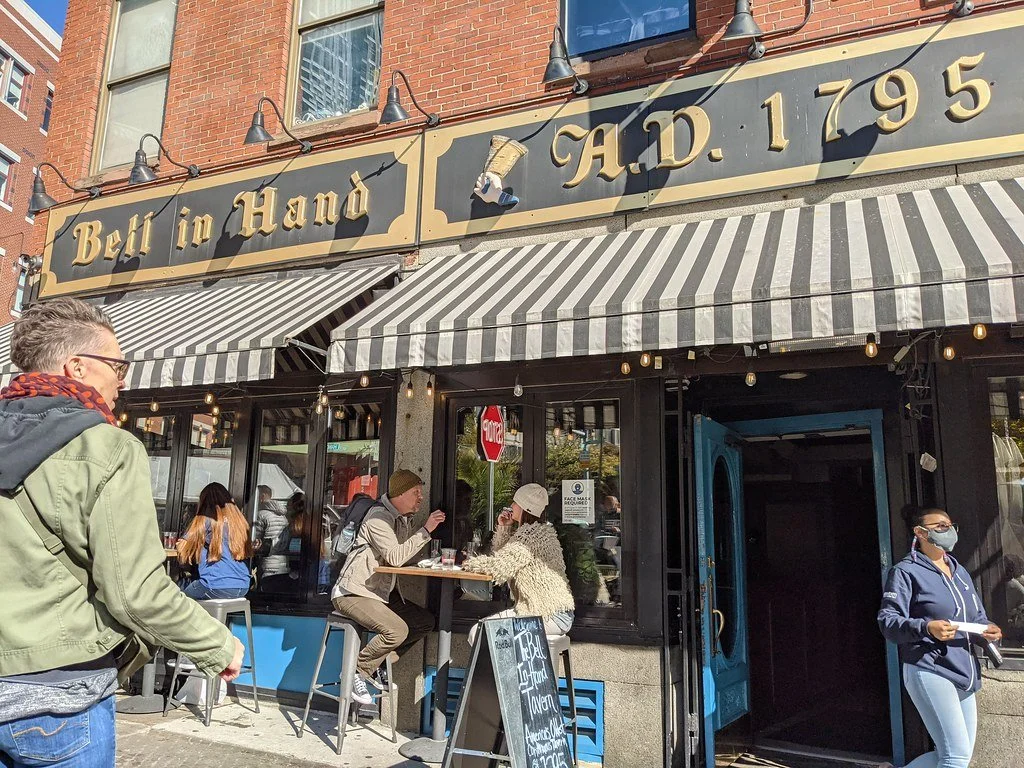
Bell in Hand began with ale
The tavern’s account of Wilson describes a man who had spent 50 years announcing the city’s news. His new business brought together printers, politicians, sailors and students. He reportedly refused to serve spirits, choosing ale over the whiskey, rum and gin available elsewhere.
One detail has outlasted the original customers: the story that the ale needed two mugs, one for the drink and another for its substantial head of foam. That is the version Bell in Hand tells about its beginnings. It gives the name something more specific than a general association with old Boston.
The opening date also puts the tavern after the American Revolution. It was not operating during the Boston Tea Party or Paul Revere’s ride. Boston’s revolutionary history and its early national history are close neighbors, but they are not interchangeable.

The oldest-tavern claim has complications
Bell in Hand advertises itself as America’s oldest continuously operating tavern. Read that as the establishment’s claim, rather than a promise that customers have been drinking in this particular room without interruption since 1795.
In Boston magazine’s examination of those long-running records, the tavern’s owner acknowledged changes of address and periods of closure. The business moved to Union Street in the 1950s, the magazine reported, and closed during Prohibition. Its present location is part of the story, not the starting point.
Earlier records complicate the timeline further. Historian Rebecca Beatrice Brooks’s account of Bell in Hand, drawing on contemporary newspapers, describes a January 1915 closure at its Pi Alley premises and a 1934 reopening on Devonshire Street. Her research also follows its old bell-and-hand sign through an auction and museum loans. The name has traveled along with the business.
None of that makes the tavern uninteresting. It gives it a history of moves, interruptions and revivals, which is more like the history of an actual city than an untouched room waiting for tourists.

What to order today
The current menu is a pub menu with plenty of seafood: New England clam chowder, fish and chips, mussels and a hot lobster roll with garlic butter. There are burgers, sandwiches and a beef shepherd’s pie, too. You do not have to turn a stop for a drink into a full dinner, but you can eat here.
The tavern currently lists daily hours of 11 a.m. to 2 a.m., with the kitchen closing at midnight. Keep that distinction in mind if you arrive late and hungry. Check directly for the evening’s entertainment or private-event arrangements before bringing a group.
Leave time for the streets around it
Bell in Hand sits in the Blackstone Block, near Faneuil Hall Marketplace. Boston’s account of the area’s street network identifies these connected roads and alleys as the city’s most intact surviving colonial-era pattern.
Walk along Union Street and into the surrounding public lanes before heading inside. The turns and narrow passages are part of what survived as Boston grew around them. For a place to get a feel for old Boston, the streets outside the tavern are doing some of the work.
