

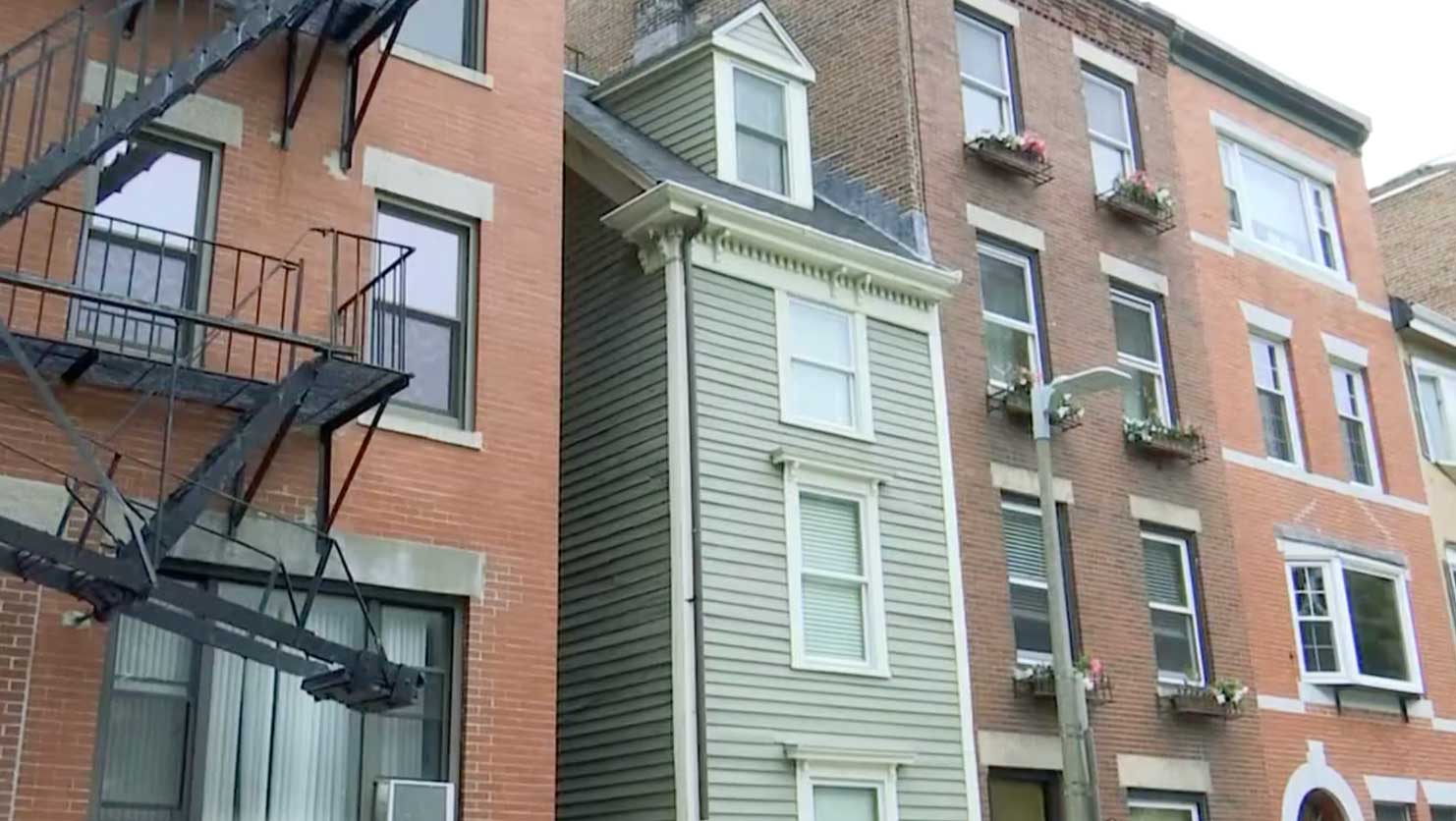
Boston’s Skinny House is about ten feet wide and sold for $1.25 million in 2021. The price is documented. The story about a furious brother building it to ruin another brother’s view is considerably less solid.
The house at 44 Hull Street faces Copp’s Hill Burying Ground in the North End. Its narrow wooden front makes a good photograph, but the building is more interesting once you stop treating the revenge story as settled history. It may be the surviving end of a much larger house.
The Skinny House revenge story
The familiar version involves two brothers who inherited land. One went away to fight in the Civil War; the other built a house that occupied most of their property. The returning brother supposedly squeezed his own house onto the remaining strip to block his sibling’s light and view.
It’s an excellent story to tell while pointing at an extremely narrow building. That doesn’t make the brothers real. In 2021, Boston.com examined Massachusetts Historical Commission records and spoke with Boston Landmarks Commission director Rosanne Foley. The records described a remnant of a larger group of wood-frame buildings, rather than a house purpose-built for revenge.
The alley beside it also mattered. It once provided access to homes behind the street frontage. Foley explained that preserving that access left too little space for the kind of replacement brick building erected next door.
What the old photographs show
Local researcher Adam Balsam reached a similar conclusion through a comparison of historic maps and photographs. His account reproduces an 1875 Boston Public Library photograph showing a larger wooden building. The surviving house’s window trim and roof details correspond to elements in that earlier frontage.
Later maps show the property divided and neighboring sections replaced with brick. The wooden sliver remained. Although accounts differ on parts of the building’s chronology, that physical evidence gives the narrow shape an explanation that doesn’t require a family feud.
Balsam also reproduces a 1920 newspaper account with a different revenge story: a Tory built the house to annoy a neighbor. No returning Civil War soldier in that version. The building has outlasted more than one explanation for its existence.
A small frontage with a full house behind it
The 2021 sale listing described 1,165 square feet, two bedrooms and one bathroom. That is more home than the street frontage suggests, distributed across several levels. The sale closed on September 16 for $1.25 million.
At the time, the kitchen and living-and-dining area occupied the lower living level, with a sitting area, laundry and bathroom above. Higher up were a guest bedroom and another living nook. The main bedroom had access to a private roof deck. The listing also showed a garden behind the house.
Those photographs answer the question the outside tends to prompt: how could anyone live in there? There is a kitchen, storage and outdoor space. There are also plenty of stairs. A narrow house can have ordinary domestic needs without an ordinary floor plan.
See it from Hull Street
The Skinny House is a private residence. Take in the front from the public sidewalk, leave the entrance clear and resist the temptation to peer through windows. The side passage isn’t an invitation to inspect the backyard.
Across the street, Copp’s Hill Burying Ground offers another reason to stop on this block. Established in 1660, it contains the graves of free and enslaved Black Bostonians, including educator and abolitionist Prince Hall. His grave has both an original headstone and a later monument. Old North Church sexton Robert Newman, associated with the signal lanterns of April 18, 1775, is buried here too.
Give the gravestones some time before heading back down the hill. The tiny house gets the photographs; the people across the street have stories of their own.