

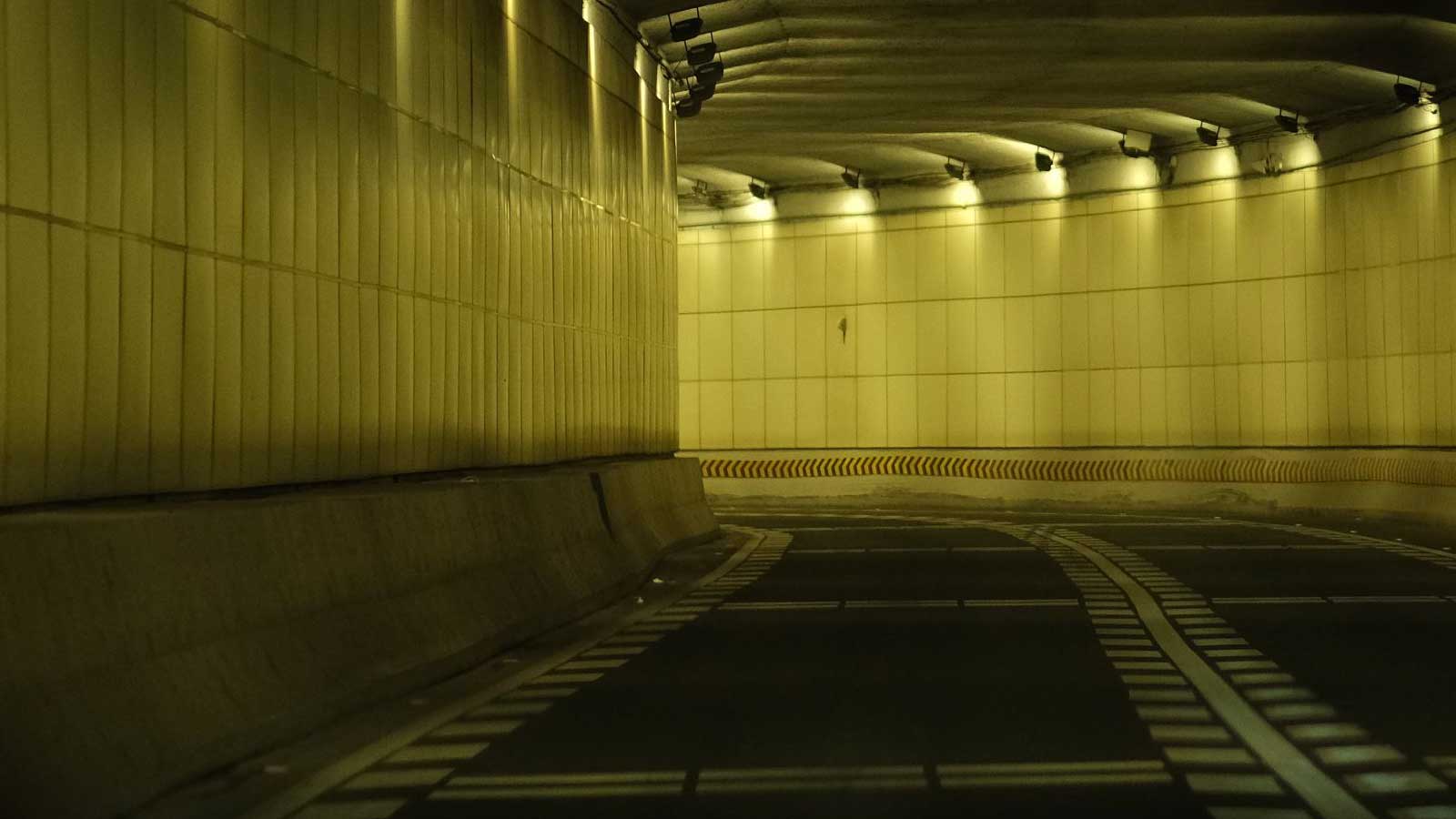
Before the Ted Williams Tunnel carried cars beneath Boston Harbor, its underwater sections came up the coast from Baltimore. Workers built twelve enormous steel tubes in a shipyard, brought them to Boston by barge and lowered them into a trench in the harbor floor.
Each section was longer than a football field. Getting one into place was a little more involved than finding a parking spot at Logan.
The crossing became part of the Big Dig, giving airport traffic another way across the harbor. Its construction story is worth knowing even if your usual interest in the tunnel begins and ends with making your flight.
How the Ted Williams Tunnel arrived by boat
The harbor section was assembled using the immersed-tube method. Rather than excavating a passage deep beneath the seabed, crews prepared a trench and set prefabricated sections into it. The finished roadway would run through those connected sections.
PBS’s account of the construction describes steel tubes measuring about 80 feet across and 40 feet high. Transporting them by water allowed a shipyard in another city to supply the pieces of a Boston highway.
There was plenty to do after they arrived. A 1996 engineering paper about the project describes the Boston outfitting work, including road surfaces, ceiling panels, lighting and wall tiles. Preparing those parts before immersion reduced the work that had to happen beneath the harbor.
The immersed portion carried four lanes, two in each direction, across approximately three-quarters of a mile. Land approaches connected it to the roads on either shore. Building the crossing therefore meant coordinating several kinds of construction: shipyard fabrication, dredging, underwater placement and the tunnels approaching from land.
Keeping the harbor outside
A tunnel section has to sink without filling the space intended for cars. It also has to meet the next section closely enough to form a watertight passage. Dropping a large tube into the water solves neither problem on its own.
Engineer Walter C. Grantz, who worked on the Boston project from 1992 to 1994, explained the immersed-tunnel construction method in a firsthand account. Temporary steel bulkheads seal the ends of a tube. Added ballast lets crews lower it while the interior stays dry.
Connecting sections involves hydraulic equipment and rubber gaskets. After the ends are pulled together, workers pump water out of the space between the bulkheads. The difference in pressure helps press the joint tightly together. A permanent water barrier is installed before the temporary barriers can be removed and the roadway continued through the connection.
The advantages begin before any of that happens. Much of the structure can be built above water, where workers can reach it more easily. An immersed tunnel can also follow a shallower route than a bored tunnel at the same crossing, reducing the distance needed to bring the road back to the surface.
Why airport traffic needed another crossing
Before the new route, traffic approaching Logan from the south and west had to travel through downtown to reach the Sumner and Callahan tunnels. The Ted Williams crossing provided a route from South Boston to East Boston, extending Interstate 90 toward the airport.
Opening the tunnel and completing its connections were separate milestones. It first opened to commercial vehicles on December 15, 1995. General traffic followed in January 2003, according to the Federal Highway Administration’s tunnel inventory, which lists the full tunnel at 1.6 miles.
That gap explains why accounts of the project can give different opening years. The harbor crossing was ready years before the completed highway connection made it available to the broader driving public.
Named for Red Sox outfielder Ted Williams, the tunnel is now an ordinary part of an airport trip. The next time you drive through, the tiled roadway around you includes a structure that was built on land, delivered by sea and deliberately sunk.