

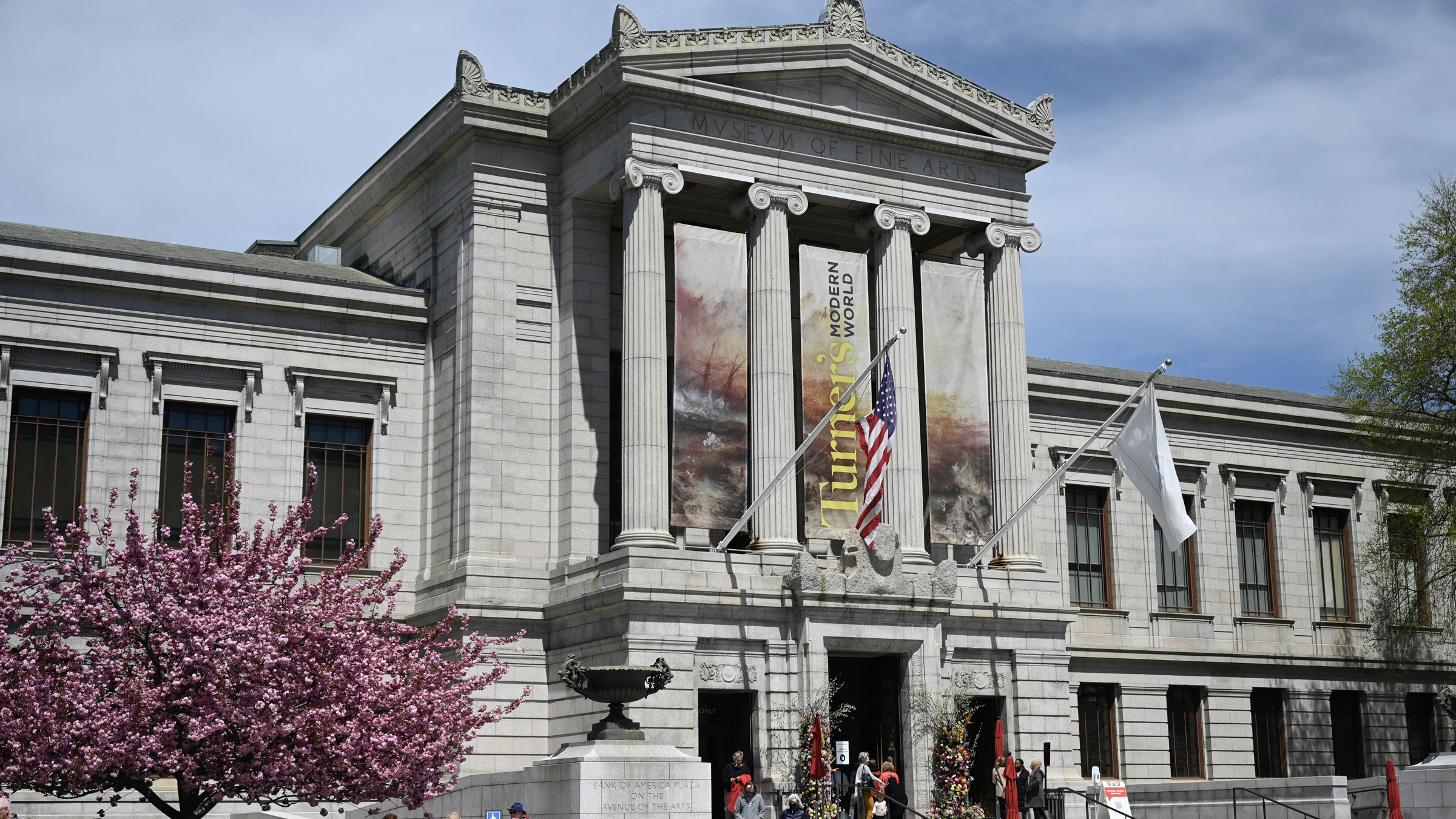
Claude Monet never visited Boston. His paintings did rather well here without him. The MFA holds one of the largest collections of his work outside France, built largely through local collectors who were buying his pictures while he was still alive.
The Monet collection has its own home in Gallery 252, the Lorna and Robert Rosenberg Gallery. It brings together works owned by the museum and selected private loans, with subjects ranging from a snow-covered village to the garden Monet built and repeatedly painted at Giverny.
You can make a visit around this room alone. The paintings reward comparison: the same artist who dressed his wife in an elaborate kimono later became absorbed in what a pond reflected.
How Boston built its Monet collection
Boston’s attachment to Monet began well before water lilies became familiar gift-shop material. The city hosted his second American solo exhibition, and local artists helped introduce collectors to his work.
The MFA’s account of those early connections includes Lilla Cabot Perry, who visited Monet in Giverny. Her brother later donated Meadow with Haystacks near Giverny (1885) to the museum. John Singer Sargent also painted in Giverny and helped American collectors gain access to Monet. Those personal relationships helped bring the paintings across the Atlantic.
When Monet died in December 1926, the MFA organized a memorial exhibition that opened just over a month later. Boston had already spent years paying attention.
La Japonaise
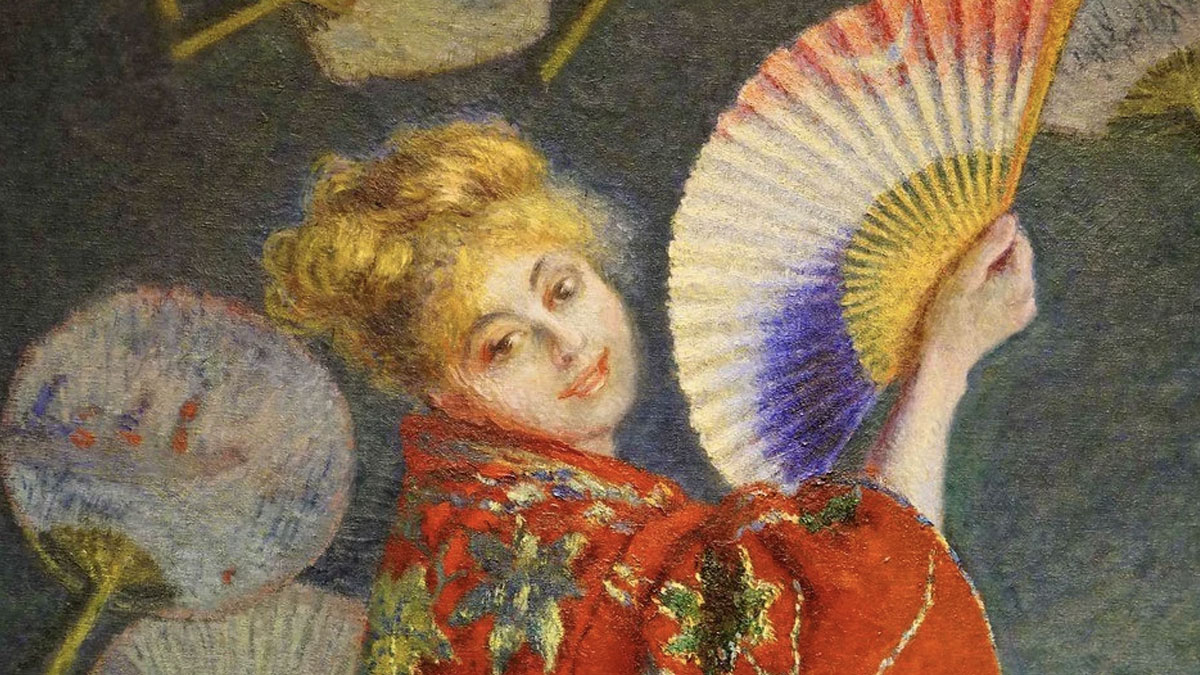
La Japonaise (Camille Monet in Japanese Costume) dates to 1876 and shows Camille wearing a blond wig and an elaborately decorated kimono. It’s a large, theatrical portrait, quite a change from the ponds and gardens that often come to mind with Monet.
The painting reflects the nineteenth-century French enthusiasm for Japanese art and objects, known as Japonisme. Camille’s costume and pose are deliberately staged. The MFA describes the blond wig as a deliberate signal of her Western identity. This is a French artist staging a portrait with Japanese objects, rather than depicting everyday life in Japan.
Look at the fan in Camille’s hand as well as the robe. Its red, white and blue decoration repeats the colors of the French flag. The MFA’s conservation account points out that the painting originally appeared under the title Japonerie, referring to Western imitations of Japanese objects.
The Water Lily Pond
The MFA’s The Water Lily Pond is dated 1900. It depicts Monet’s garden at Giverny, where he settled in 1883 and bought a house in 1890. He subsequently acquired more land and made a water garden, with a Japanese bridge crossing the narrow part of the pond.
The museum describes this painting as one of his early works to emphasize reflections of the bank and sky across the water’s surface. Spend a moment sorting out what is growing around the pond and what you’re seeing reflected in it. The water carries much of the picture.
The painting entered the MFA in 1961 as a gift from the Fuller Foundation, in memory of former Massachusetts governor Alvan T. Fuller. Another French garden, another Boston connection.
Rouen Cathedral
In Rouen Cathedral Façade and Tour d’Albane (Morning Effect), dated 1894, a building becomes a study of changing light. Monet worked from rooms facing the cathedral, switching between paintings as conditions changed during the day.
He later reworked the series in his Giverny studio. These weren’t simply quick impressions left untouched after a morning outside. The MFA points to the thick layers of paint, which echo the rough surface of weathered stone.
The portrait, pond and cathedral show how far Monet could move between subjects. Compare how much of each picture depends on a solid object and how much depends on the light falling on it.
A later Monet, and time to see it
The gallery also features Water Lilies, Reflections of Weeping Willows, painted around 1916–19 and on loan from a private collection. It comes from later in Monet’s career than the paintings the MFA owns, with deep colors and a composition moving toward abstraction.
That loan is another reason to distinguish the collection from what happens to be hanging today. Check the museum’s gallery updates and individual artwork records before a visit built around a particular painting; temporary moves are possible.
The MFA is closed Tuesdays and stays open until 10 p.m. on Thursdays and Fridays. Those later hours leave room to combine the gallery with dinner in Fenway. Have dinner first if you want a long, unhurried look afterward. Last admission is thirty minutes before closing, which is an entrance deadline, not a sensible amount of time to give Monet.
