

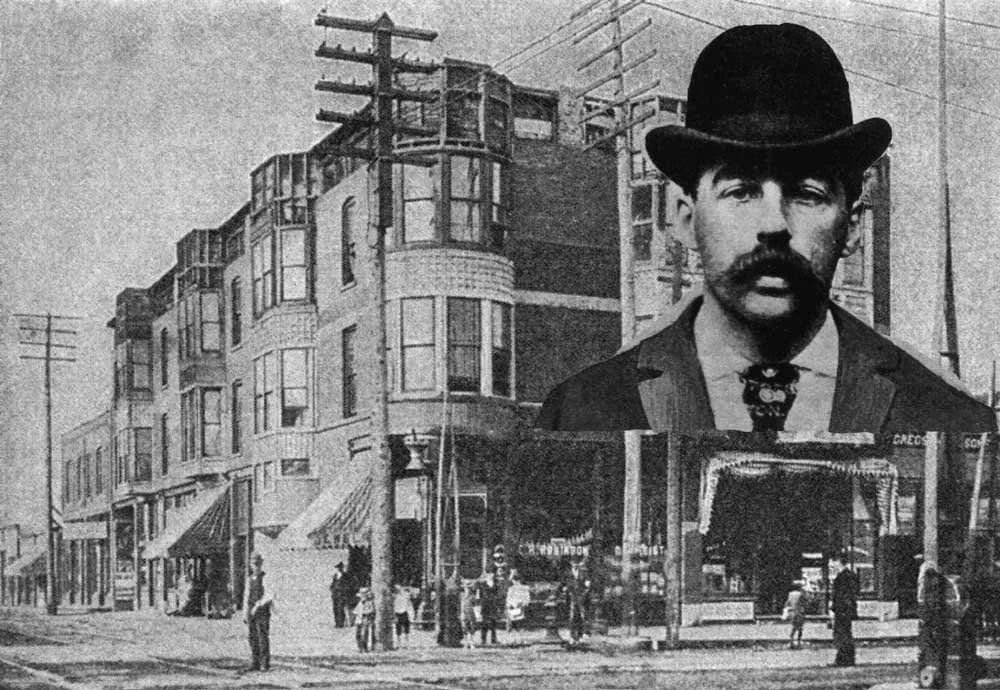
H.H. Holmes was arrested in Boston while using another man’s name. On November 17, 1894, Boston police and a Pinkerton detective caught up with him after he checked into a West End boarding house as H.M. Howell of Denver. The case that brought them there involved a $10,000 insurance fraud.
Holmes is usually associated with Chicago and the building called the “Murder Castle.” Boston was where his freedom ended. His arrest led back to a dead business associate in Philadelphia, three missing children and a succession of stories that Holmes changed whenever one stopped being useful.
The facts are grim enough without the trapdoors and death tolls that have accumulated around his name.
What brought H.H. Holmes to Boston
Born Herman Mudgett in New Hampshire, Holmes trained as a doctor before becoming known for fraud and murder. The West End Museum’s account of his Boston arrest places him in the neighborhood under the Howell alias. Officers didn’t arrive with a solved case involving hundreds of victims. They were following a financial scheme.
Holmes and Benjamin Pitezel had arranged to fake Pitezel’s death and collect his life insurance. Pitezel actually died. Holmes continued telling Pitezel’s wife that her husband was alive, while keeping three of their children with him.
A former jail acquaintance, Marion Hedgepeth, helped expose the scheme. Holmes had promised him money for an introduction to a lawyer and failed to pay. Hedgepeth told the authorities what he knew. For a man who depended on manipulating people, leaving an accomplice unpaid was a consequential decision.
The story kept changing after the arrest
In H.B. Irving’s historical account of the case, Holmes responded to his arrest by claiming that a substitute body had been shipped from New York to Philadelphia. Pitezel, he said, had gone to South America with three of his children. That explanation protected the insurance-fraud story while concealing the deaths.
Holmes was transferred from Boston to Philadelphia. Finding out what had happened to the children required a separate investigation, led by Philadelphia detective Frank Geyer in 1895. He retraced their movements through hotel records, rental properties and witnesses who remembered Holmes under different names.
Letters recovered during the investigation showed the children asking why their mother hadn’t written. Correspondence between them had been intercepted.
The children were Alice, Nellie and Howard Pitezel. Investigators found the girls’ remains in Toronto and Howard’s remains in the Indianapolis area. Their mother had been waiting for a reunion while Holmes moved members of the family between cities and kept them apart.
Holmes went on trial in Philadelphia in October 1895 for Benjamin Pitezel’s murder. He was convicted and was hanged on May 7, 1896. The conviction concerned a specific victim and a specific crime, rather than the enormous catalogue of murders later attached to his name.
The problem with the Murder Castle story
The familiar version turns Holmes into the proprietor of a hotel built to kill visitors to the 1893 Chicago World’s Fair. It often gives him 200 victims. Neither claim should be read as a settled account of what happened.
Researcher Adam Selzer has spent years examining the claims against the records. He disputes the 200-victim figure and the description of the building as a conventional hotel. Shops, rented rooms, financial fraud and sensational newspaper coverage all became ingredients in a much tidier horror story.
A Smithsonian review of the evidence also describes how Holmes’s own falsehoods and later retellings complicated the history. The number of people he killed remains uncertain. That uncertainty doesn’t erase the Pitezel family or the investigation that followed his Boston arrest.
For a longer telling, Morbid’s H.H. Holmes series begins with his capture in the West End. It is the Boston part of a story more often told through Chicago.