

BREAKING: World Economic Forum says COVID was a global test of ‘social responsibility’
A document published by the World Economic Forum explicitly describes the COVID-19 pandemic as a real-world test of public compliance with large-scale behavioral measures, framing the period as proof that billions of people can accept sweeping restrictions when authorities present them as necessary for the collective good.
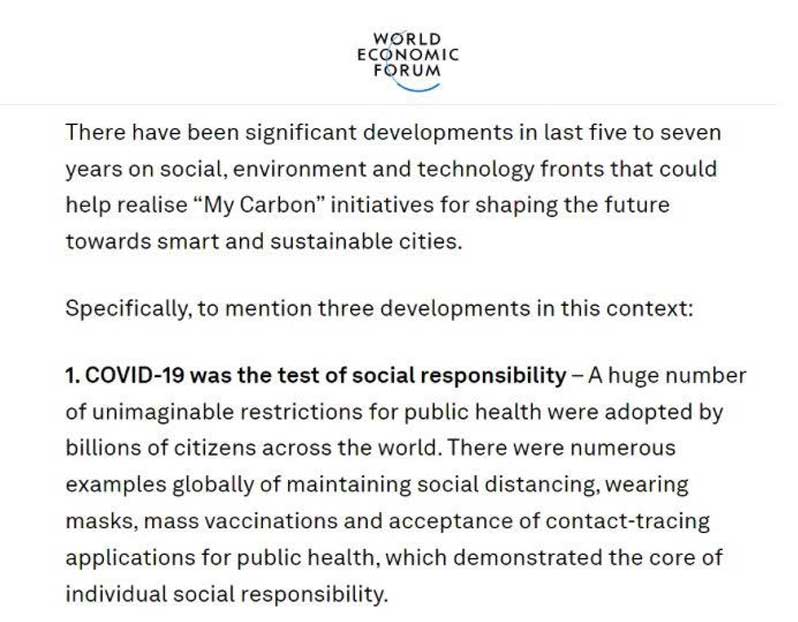
The text appears in a World Economic Forum paper discussing the development of “My Carbon” initiatives, a concept linked to future climate and sustainability policy. The document states that major social, environmental, and technological changes over the past five to seven years could help advance systems designed to guide behavior in “smart and sustainable cities.”
Within that context, the Forum points to COVID-19 as the clearest example. It describes the pandemic as a “test of social responsibility,” noting that unprecedented public-health measures were adopted worldwide. These included social distancing rules, mask mandates, mass vaccination campaigns, and the widespread acceptance of digital contact-tracing applications.
According to the document, the scale and speed of public compliance demonstrated that populations across different countries were willing to alter daily behavior, accept movement restrictions, and use digital monitoring tools when those measures were presented as serving public health goals.
The paper does not use the phrase “New World Order.” It does, however, frame the pandemic response as evidence that coordinated global action and individual behavioral compliance are achievable, and it cites that experience as relevant to future policy discussions around carbon tracking, sustainability targets, and urban governance.
In plain terms, the Forum is arguing that COVID proved something policymakers have long debated: large populations will comply with far-reaching rules, including digital systems tied to personal behavior, if those rules are justified as necessary for a broader societal objective.




4 Comments